Craniosacral Therapy: What a Chiropractic Physician Uses When Your Nervous System Needs More Than an Adjustment
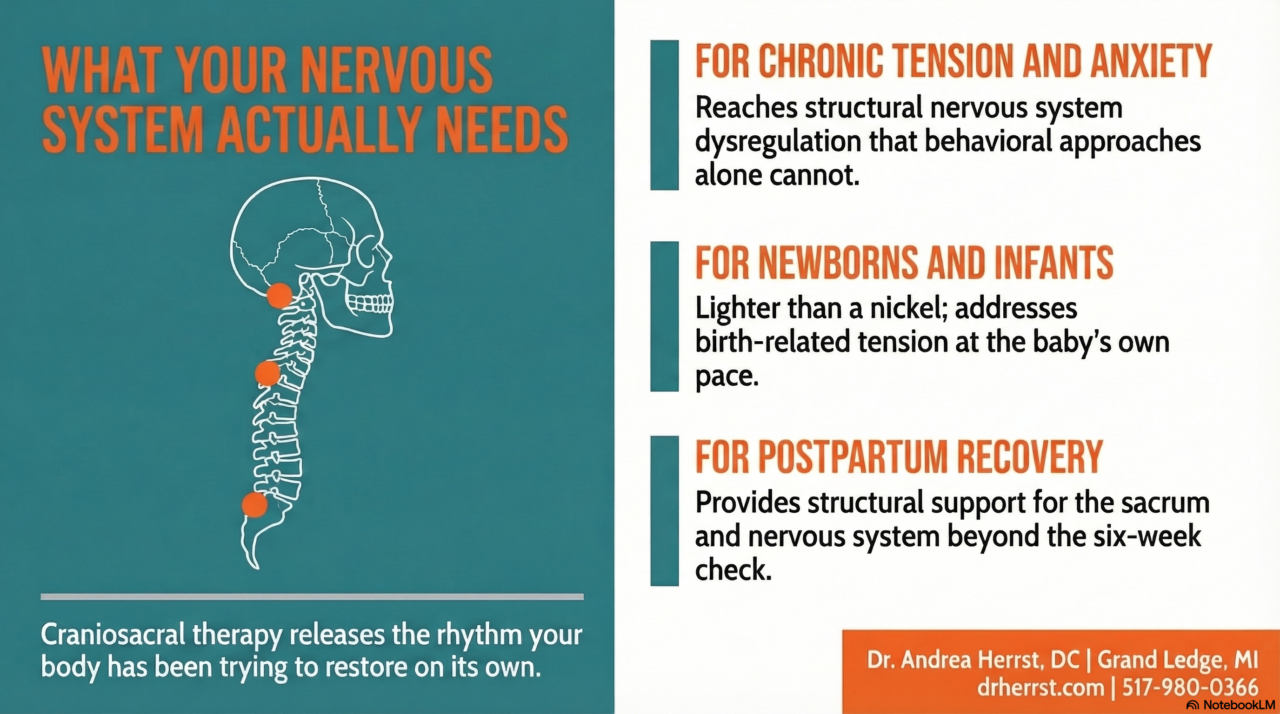
Craniosacral therapy is a gentle, hands-on technique used by chiropractic physicians to release tension held deep in the nervous system. It can help with headaches, anxiety, sleep, postpartum recovery, and even feeding and settling difficulties in newborns. There is no force involved. Most people describe it as one of the most deeply calming things their body has ever experienced. If you have wondered whether there is something more than what you have already tried, this is worth understanding. Prefer to listen instead? Something Hasn’t Felt Right for a While You know the feeling. Not dramatic. Not emergency-room urgent. Just a low-grade hum of something off that you have gotten very good at pushing through. Maybe it is the headache that shows up every afternoon like it has somewhere to be. Or the tension that lives between your shoulder blades and the base of your skull, the kind that a hot shower helps for twenty minutes before it comes right back. Maybe your child has been harder to settle than you expected, and every explanation you have been given starts with “some babies are just like that.” Maybe you have not slept deeply in so long that you genuinely cannot remember what rested feels like. You have probably been told your labs look normal. That everything checks out. That stress is likely the cause. You have stretched. You have tried the supplements. You have done the things you were supposed to do. And the hum is still there. Here is something worth considering. The nervous system is patient. It will keep adapting to whatever load you place on it. Over time, that adaptation becomes the new normal. Tired becomes “just how I am.” Tense becomes “just how I carry stress.” The afternoon headache becomes “just part of my week.” The body does not announce that it is struggling. It just quietly reorganizes itself around the problem. If you recognize this pattern, these stress management strategies are worth reading alongside this post. Every month that pattern runs unaddressed, it becomes more familiar to your body than the alternative. The body does not forget. It learns. That is not a character flaw. It is not a failure of willpower. It is physiology. And physiology can change when you address the right thing. What If Your Nervous System Is the Root, Not the Symptom? Craniosacral therapy is a gentle, hands-on technique that works with the deepest structures of your nervous system. Not the muscles on the surface. Not the joints in isolation. The bones of your skull, your spine, and your sacrum, and the fluid that moves through all of them. Here is the physiology in plain terms. Your body produces a fluid called cerebrospinal fluid. It bathes your brain and spinal cord and moves in a slow, rhythmic pulse that has nothing to do with your heartbeat and nothing to do with your breathing. It is its own system, running quietly underneath everything else. A trained practitioner can feel that rhythm with her hands. When something disrupts that rhythm, the nervous system notices. It compensates. It adapts. And the adaptation shows up as the thing you came in for, whether that is the headache, the tension that will not release, the child who will not settle, or the anxiety that does not have a clean explanation. Craniosacral therapy finds where the rhythm is restricted and releases it. Gently. With no force. The work is so light that most people are surprised by how much they feel. This is not a wellness trend. It is a clinical tool used inside a chiropractic physician’s practice by a physician trained to understand the nervous system at depth. If you have wondered whether your current care is getting all the way to the root, this is the question worth asking. If your first instinct is to wonder whether this is real, that is a good instinct. Bring it. The evidence is worth knowing, and it will be addressed in the FAQ below. Dr. Herrst’s Note — Physiology Corner Craniosacral therapy works with a rhythm your body already produces on its own. I can feel it with my hands. When it is restricted, I find where and release it. Gently. With no force at all. The response often surprises people who expected something more dramatic. The body does not need drama. It needs precision. That is what this work is. What Craniosacral Therapy Actually Addresses, and Who It Is For Some of the patterns that bring people to this kind of care most often: headaches that arrive without a clear cause, tension that lives in the upper neck and base of the skull, a newborn who seems uncomfortable in ways no one can quite name, postpartum recovery that still does not feel complete months after delivery, and anxiety that does not have a clean explanation. None of these have to be permanent. They are patterns. And patterns can change. To learn more about Dr. Herrst’s approach and background, her About page gives the full picture. For the Tension You Have Learned to Live With The nervous system can get stuck in a state of low-grade alert. Not panic. Not crisis. Just a persistent background hum of not-quite-right that has become the new baseline. Most approaches to chronic tension and anxiety focus on behavior. Breathe differently. Think differently. Move more. Those things matter. But when the nervous system has a structural component to its dysregulation, behavioral approaches alone hit a ceiling. Craniosacral therapy works with the structural side of that equation. The bones of the skull and the upper cervical spine have a direct relationship with the nervous system’s ability to shift out of a stress response. When those structures are restricted, the system stays elevated. When the restriction is released, the body finally gets the signal that it is allowed to come down. This is the piece that grounding techniques and breathing exercises cannot always reach on their own. If you have worked hard on the