
Craniosacral therapy is a gentle, hands-on technique used by chiropractic physicians to release tension held deep in the nervous system. It can help with headaches, anxiety, sleep, postpartum recovery, and even feeding and settling difficulties in newborns. There is no force involved. Most people describe it as one of the most deeply calming things their body has ever experienced. If you have wondered whether there is something more than what you have already tried, this is worth understanding.
Prefer to listen instead?
Something Hasn’t Felt Right for a While
You know the feeling. Not dramatic. Not emergency-room urgent. Just a low-grade hum of something off that you have gotten very good at pushing through.
Maybe it is the headache that shows up every afternoon like it has somewhere to be. Or the tension that lives between your shoulder blades and the base of your skull, the kind that a hot shower helps for twenty minutes before it comes right back. Maybe your child has been harder to settle than you expected, and every explanation you have been given starts with “some babies are just like that.” Maybe you have not slept deeply in so long that you genuinely cannot remember what rested feels like.
You have probably been told your labs look normal. That everything checks out. That stress is likely the cause. You have stretched. You have tried the supplements. You have done the things you were supposed to do.
And the hum is still there.
Here is something worth considering. The nervous system is patient. It will keep adapting to whatever load you place on it. Over time, that adaptation becomes the new normal. Tired becomes “just how I am.” Tense becomes “just how I carry stress.” The afternoon headache becomes “just part of my week.” The body does not announce that it is struggling. It just quietly reorganizes itself around the problem. If you recognize this pattern, these stress management strategies are worth reading alongside this post.
Every month that pattern runs unaddressed, it becomes more familiar to your body than the alternative. The body does not forget. It learns.
That is not a character flaw. It is not a failure of willpower. It is physiology. And physiology can change when you address the right thing.
What If Your Nervous System Is the Root, Not the Symptom?
Craniosacral therapy is a gentle, hands-on technique that works with the deepest structures of your nervous system. Not the muscles on the surface. Not the joints in isolation. The bones of your skull, your spine, and your sacrum, and the fluid that moves through all of them.
Here is the physiology in plain terms.
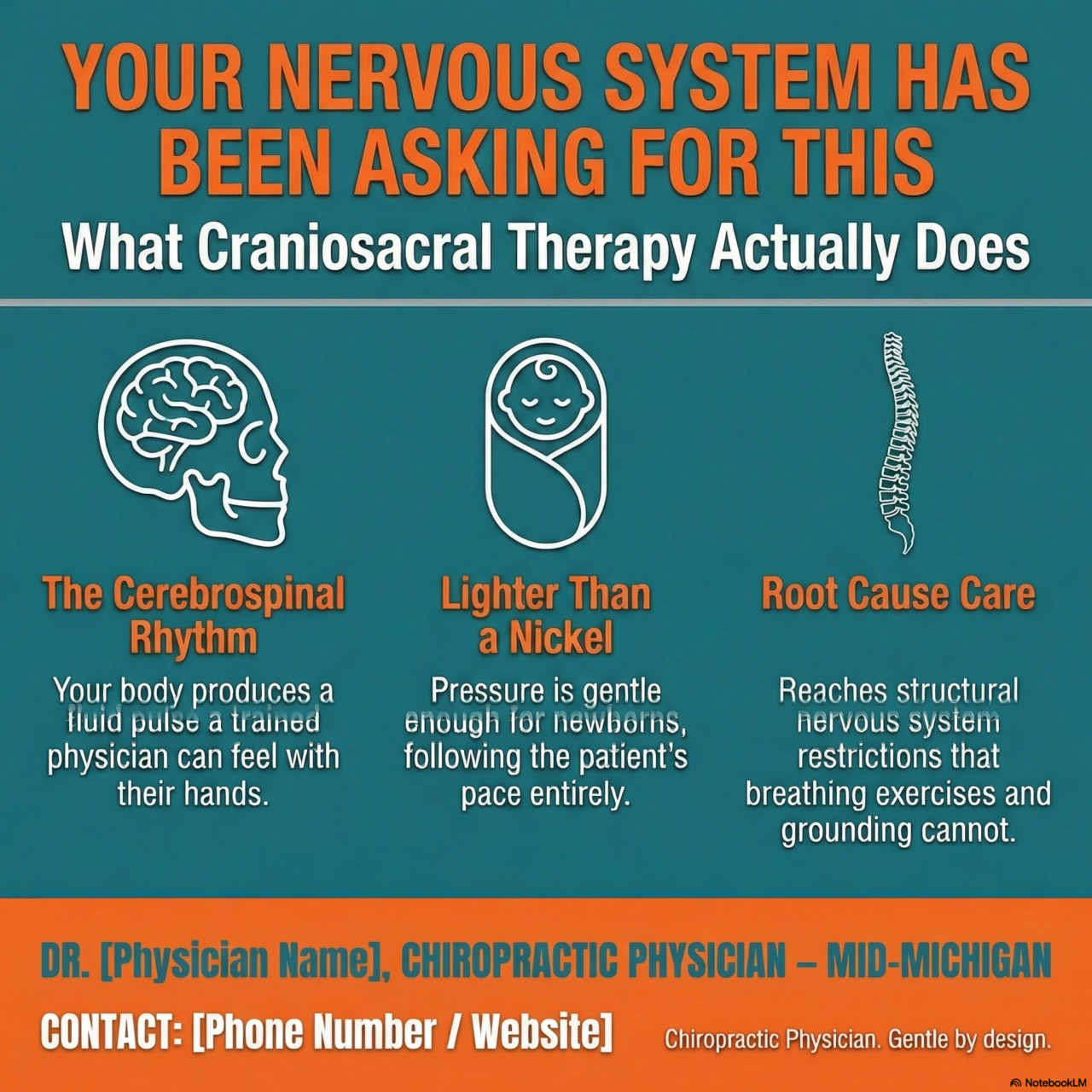
Your body produces a fluid called cerebrospinal fluid. It bathes your brain and spinal cord and moves in a slow, rhythmic pulse that has nothing to do with your heartbeat and nothing to do with your breathing. It is its own system, running quietly underneath everything else. A trained practitioner can feel that rhythm with her hands.
When something disrupts that rhythm, the nervous system notices. It compensates. It adapts. And the adaptation shows up as the thing you came in for, whether that is the headache, the tension that will not release, the child who will not settle, or the anxiety that does not have a clean explanation.
Craniosacral therapy finds where the rhythm is restricted and releases it. Gently. With no force. The work is so light that most people are surprised by how much they feel.
This is not a wellness trend. It is a clinical tool used inside a chiropractic physician’s practice by a physician trained to understand the nervous system at depth. If you have wondered whether your current care is getting all the way to the root, this is the question worth asking.
If your first instinct is to wonder whether this is real, that is a good instinct. Bring it. The evidence is worth knowing, and it will be addressed in the FAQ below.
Dr. Herrst’s Note — Physiology Corner
Craniosacral therapy works with a rhythm your body already produces on its own. I can feel it with my hands. When it is restricted, I find where and release it. Gently. With no force at all. The response often surprises people who expected something more dramatic. The body does not need drama. It needs precision. That is what this work is.
What Craniosacral Therapy Actually Addresses, and Who It Is For
Some of the patterns that bring people to this kind of care most often: headaches that arrive without a clear cause, tension that lives in the upper neck and base of the skull, a newborn who seems uncomfortable in ways no one can quite name, postpartum recovery that still does not feel complete months after delivery, and anxiety that does not have a clean explanation. None of these have to be permanent. They are patterns. And patterns can change. To learn more about Dr. Herrst’s approach and background, her About page gives the full picture.
For the Tension You Have Learned to Live With
The nervous system can get stuck in a state of low-grade alert. Not panic. Not crisis. Just a persistent background hum of not-quite-right that has become the new baseline.
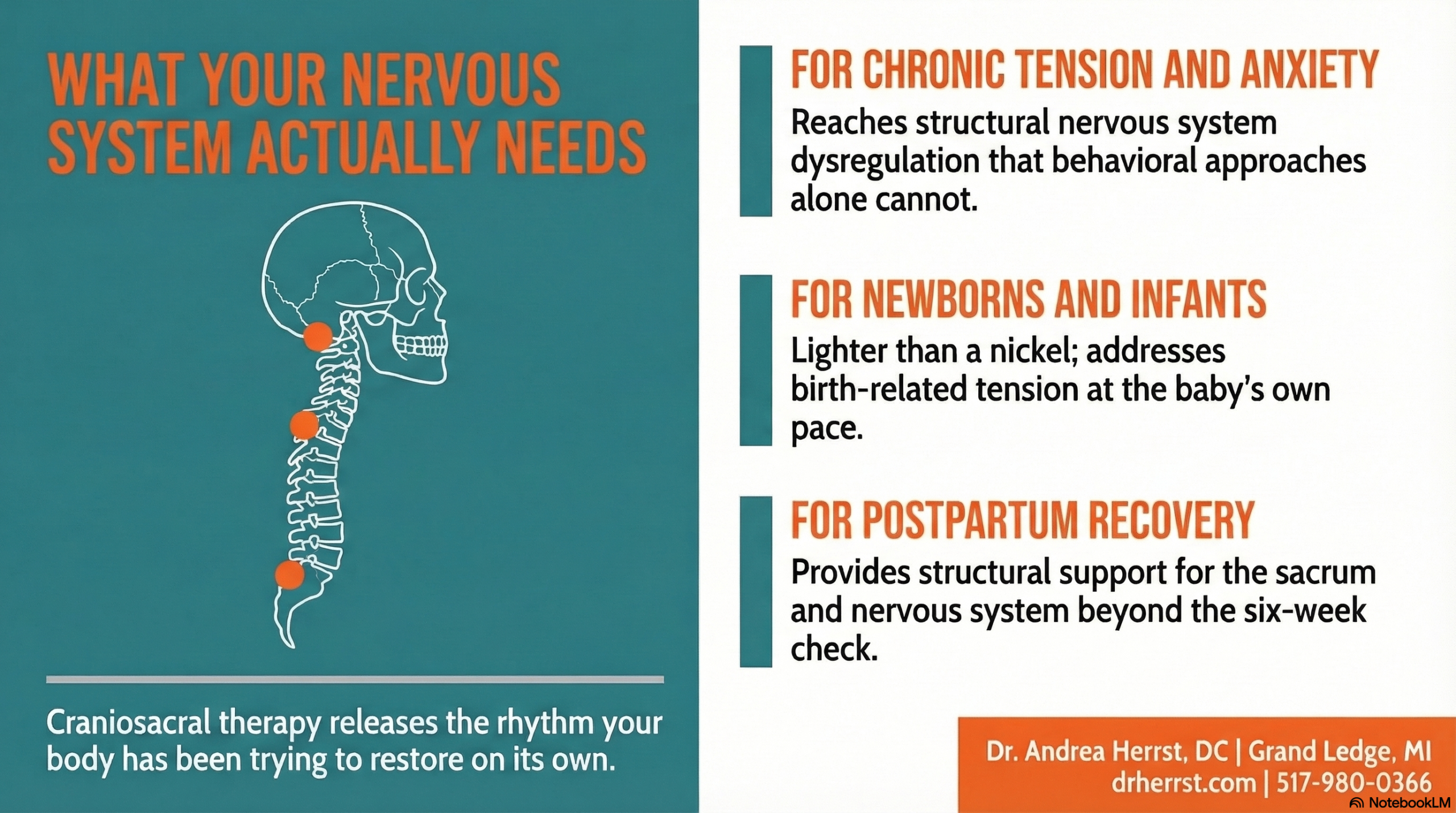
Most approaches to chronic tension and anxiety focus on behavior. Breathe differently. Think differently. Move more. Those things matter. But when the nervous system has a structural component to its dysregulation, behavioral approaches alone hit a ceiling.
Craniosacral therapy works with the structural side of that equation. The bones of the skull and the upper cervical spine have a direct relationship with the nervous system’s ability to shift out of a stress response. When those structures are restricted, the system stays elevated. When the restriction is released, the body finally gets the signal that it is allowed to come down.
This is the piece that grounding techniques and breathing exercises cannot always reach on their own. If you have worked hard on the behavioral side and still feel stuck, this is often why. For a deeper look at how the nervous system gets locked in these patterns, the post How to Reset a Dysregulated Nervous System — When Grounding Techniques Aren’t Enough goes further.

For Your Baby, From the Very Beginning
Birth is one of the most physically demanding experiences the human body goes through, for the baby as much as for the mother. Even an uncomplicated delivery places significant pressure on the newborn’s skull, neck, and upper spine. Long labor, positioned deliveries, vacuum assistance, and cesarean births each carry their own structural implications for the baby’s nervous system in those early weeks. Chiropractic care during pregnancy addresses many of these same structural considerations from the mother’s side — and what happens in utero shapes what the baby carries into those first days.
The result is not always visible. It shows up as a baby who is hard to settle. Who startles easily. Who feeds with difficulty on one side. Who seems tense in a way you cannot explain. These are not personality quirks. They are patterns. And gentle, precise care can address them.
The pressure used in craniosacral therapy for an infant is lighter than the weight of a nickel. The session follows the baby’s pace entirely. If a baby needs to nurse, that is welcome. If a toddler needs to move around the room, that is expected. If a child needs to be held during the session, that is exactly what happens. The appointment is not run on a clinical clock. It is run by the patient.
Dr. Herrst’s Note — On Working With Newborns
The gentleness of this technique is something I think about every single time I work with a newborn. Lighter than a coin on the palm of your hand. The nervous system responds not because anything was pushed or forced, but because it finally had space to release what it was holding. Every session with a baby is led entirely by the baby. That is not a concession to comfort. That is the clinical design.
After Pregnancy, When Cleared Is Not the Same as Recovered
The six-week postpartum visit is a safety checkpoint. It is not a recovery milestone. Most women leave that appointment with a clearance and very little else — no evaluation of the sacrum, no assessment of pelvic floor tension, no attention to the nervous system state after the significant physical demands of pregnancy and delivery. Conditions like symphysis pubis dysfunction are a good example of the structural load pregnancy places on the pelvis that rarely gets addressed at that standard clearance visit.
Craniosacral therapy in the postpartum period works with the sacrum, the base of the skull, and the nervous system as a whole — all of which absorb the physical demands of carrying and delivering a baby. Many women describe this care as the first time their body felt genuinely supported after birth, not just checked.
How This Fits Within Chiropractic Care
Most people carry a mental model of chiropractic care that is built on a single tool and a single approach. You come in, the same thing happens every visit, and you leave. That is one version of chiropractic. It is not this one.
Dr. Herrst is a chiropractic physician. That distinction matters. A physician brings clinical judgment to every visit, not a protocol. What happens during a session is determined by what she finds, not by what happened last time. Craniosacral therapy is one tool in that clinical toolkit. So is instrument-based low-force technique. So is Graston Technique. So is the whole-person assessment that starts every visit.
When the nervous system needs something gentle and deeply restorative, craniosacral therapy is often the right choice. When the spine needs structural input, other precision tools are used. Sometimes both happen in the same visit. The approach follows the clinical picture, because no two patients are the same and no two visits are identical.
This is what it means to be cared for by a physician rather than processed by a system.
If You Are Ready to Find Out What Your Body Has Been Asking For
The nervous system has been holding this pattern for a while. One session begins the conversation. Most people notice something shifts after the first visit — in how they sleep, how they carry tension, how their baby settles. The full picture takes time, and that is not a caveat. That is how the body works. The nervous system does not change overnight. It changed gradually over months or years, and it unwinds gradually too. We expect that, and we plan for it.
Finding Craniosacral Therapy Near Me in Mid-Michigan
Dr. Herrst’s practice is located at 221 S Bridge Street in downtown Grand Ledge, just a short walk from the Island Park ledges — which feels right for a practice built on the belief that real healing happens close to home. The practice serves families from across Eaton and Ingham counties, including Grand Ledge, Waverly, Delta Township, DeWitt, Mason, Charlotte, and the greater Lansing area.
If you have been looking for a chiropractic physician in mid-Michigan who offers craniosacral therapy for yourself, for your baby, or for your family as a whole, this is one of the few practices in the region where that care is available under direct physician oversight.
The first visit is one hour. It starts with a real conversation, not a rushed intake form. There is no pressure and no predetermined plan. Before you call, you are welcome to review fees and payment options so you come in knowing exactly what to expect. Just an honest look at what is happening and whether this practice is the right fit for you and your family.
You have been managing this long enough. If something in this post resonated, that is worth paying attention to. Your body has been asking for something. It may be time to find out what.
Schedule your first visit— or call 517-980-0366 to talk first.
Frequently Asked Questions About Craniosacral Therapy
What is craniosacral therapy?
Craniosacral therapy is a gentle, hands-on clinical technique that works with the bones of the skull, the spine, and the sacrum, along with the membranes and fluid that surround and protect the brain and spinal cord. A trained practitioner uses very light touch to feel the rhythm of the cerebrospinal fluid and find areas where that rhythm is restricted. When those restrictions are released, the nervous system can function more freely. It is used for a wide range of concerns, from chronic headaches and anxiety in adults to settling and feeding difficulties in newborns. If you are wondering whether it might be right for you, the best first step is a new patient visit where Dr. Herrst can assess what your body specifically needs.
How does craniosacral therapy work?
The body produces a rhythmic pulse of cerebrospinal fluid that moves through the skull, spine, and sacrum in a slow, continuous cycle. This rhythm is separate from the heartbeat and the breath. When the bones and connective tissue around this system are restricted, the rhythm is disrupted. A craniosacral therapist trained in this technique can feel that disruption and use precise, gentle contact to release it. The pressure involved is so light that many people are surprised during their first session. The nervous system responds not to force but to precision, which is exactly what this work provides.
Can craniosacral therapy help with anxiety and stress?
This is one of the most common reasons adults seek this care, and the results are often meaningful. Chronic anxiety and stress dysregulate the nervous system over time, keeping it in a state of low-grade alert even when there is no immediate threat. Craniosacral therapy works with the structural components of that state — particularly the upper cervical spine and the base of the skull — which have a direct relationship with the body’s ability to shift out of a stress response. For many people, this is the layer of care that behavioral approaches alone could not fully reach. The post Stress Management Techniques That Actually Address What Your Body Is Trying to Tell You covers the behavioral side of this equation in depth and pairs well with the structural work done here.
Is craniosacral therapy safe for babies and children?
Yes. The technique is adapted entirely to the patient’s size, age, and needs. For infants, the pressure used is lighter than the weight of a small coin. Sessions follow the baby’s pace. Nursing, moving, and being held are all welcome during a session. The work is designed to be gentle enough for a newborn’s nervous system and specific enough to be clinically meaningful. It is used with newborns for concerns such as difficulty settling, feeding challenges, tension after birth, and disrupted sleep patterns. For more on chiropractic care during pregnancy and early family care, that post walks through safety questions in detail.
What conditions does craniosacral therapy address?
In adults, patterns that commonly respond to this work include chronic headaches, migraines, neck and upper back tension, jaw tension, sleep difficulties, anxiety, and nervous system dysregulation. In the postpartum period, it is used for sacral recovery, pelvic tension, and nervous system support after the physical demands of birth. In infants and children, it is used for colic, difficulty settling, feeding challenges, sensory sensitivity, and the structural effects of birth. It is also used as part of a broader chiropractic care plan for patients whose symptoms have not fully resolved with other approaches. For those navigating fertility alongside these concerns, natural fertility support is another area where whole-body structural care plays a meaningful role.
How is craniosacral therapy different from a chiropractic adjustment?
A chiropractic adjustment uses precise input to restore motion and alignment to specific joints of the spine and pelvis. Craniosacral therapy works with a different layer entirely — the membranes and fluid surrounding the nervous system — through extremely gentle sustained contact rather than a directed thrust. Both are clinical tools. Both address root causes rather than symptoms. At this practice, the choice of which tool to use — or whether to use both in the same visit — is made based on what the examination finds. The approach follows the patient, not the other way around. The Webster Technique is another specialized tool Dr. Herrst uses particularly during pregnancy, and it similarly prioritizes precision over force.
Is craniosacral therapy real? What does the research show?
That is a fair question, and it deserves a direct answer. The research base for craniosacral therapy is growing but still developing, as is true for many manual therapy techniques. Studies published through the National Institutes of Health have examined its application for chronic pain, migraines, anxiety, and infant colic, with a number of positive findings. The technique was developed and codified by Dr. John Upledger at the Upledger Institute following years of anatomical research, and it is now taught in clinical settings worldwide. As with most manual therapies, the quality of outcomes depends significantly on the training and clinical judgment of the practitioner. At this practice, craniosacral therapy is offered as one component of physician-directed, whole-person care — not as a standalone treatment outside a clinical framework.
What should I expect at my first craniosacral therapy session in Grand Ledge?
Your first visit at Dr. Herrst’s practice begins with a full conversation. She wants to understand your history, what you have already tried, what your daily life looks like, and what your body has been telling you. From there, she conducts a thorough examination. If craniosacral therapy is part of what she recommends, she will explain what she is finding and why that approach fits your specific situation. Sessions are fully clothed. The work is quiet and gentle. Most people leave their first session feeling noticeably calmer than when they arrived. The office is located at 221 S Bridge Street in downtown Grand Ledge. You can reach the practice at 517-980-0366 or book online at drherrst.com.