
Abdominal massage for fertility works by improving blood flow to the uterus and ovaries, releasing fascial restrictions that limit organ mobility, gently repositioning the uterus when structural alignment is needed, supporting lymphatic drainage, and calming the nervous system so your body can shift out of survival mode and into the conditions where conception becomes possible. It is both mechanical and physiological, grounded in anatomy, and it works best when performed by a certified practitioner who understands the full picture of your reproductive health.
Prefer to listen instead?
You already know what you’re hoping for. You don’t need anyone to describe it. The positive test. The way you’d tell your husband. The way your older kids would react. You carry that picture with you, and it is the reason you keep asking questions, keep researching, keep trying.
So let’s start there. With where you’re going, not where you’ve been.
Most women who come to see me have spent months, sometimes longer, asking some version of the same question: “What is wrong with me?” They’ve tracked their cycles. They’ve taken the supplements. They’ve read the books and followed the advice and done everything the right way. And they are exhausted from trying so hard and still not having answers that feel real.
Here is what I want you to consider. What if the better question isn’t “what’s wrong with me?” but “what does my body need that it isn’t getting right now?”
That one shift changes everything.
For many women, the answer turns out to be surprisingly physical. Not emotional. Not mysterious. Structural. Circulatory. Mechanical. And that is where abdominal massage enters the conversation, not as a last resort or a long shot, but as a legitimate physiological tool with deep roots in traditional medicine and a clear anatomical explanation for why it works.
Why Your Uterus Position Matters More Than Anyone Told You
Most women have never been told that their uterus has a position, that it can shift from that position, and that when it does, the entire environment for conception changes with it.
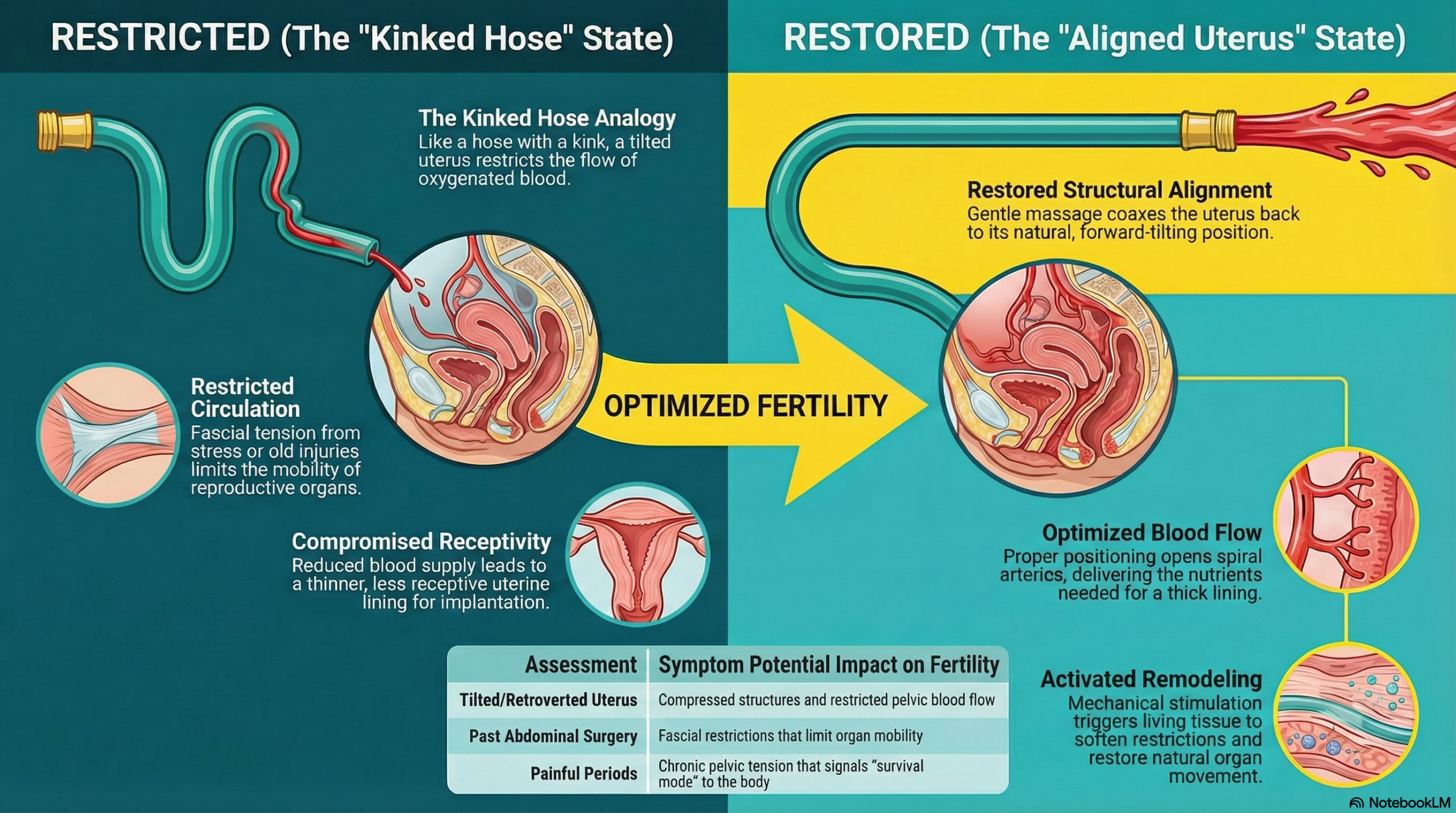
Think about a garden hose lying in your backyard on a summer afternoon. The water is there. The pressure is there. But if someone steps on that hose, or it bends around a corner too sharply, the water slows to a trickle. It can’t reach the garden no matter how much pressure is behind it.
Your uterus, ovaries, and fallopian tubes need a steady, rich flow of oxygenated blood to do their jobs. When your uterus is tilted forward, backward, or to one side, which is far more common than most women know, or when the connective tissue surrounding it has tightened from past surgeries, old injuries, previous pregnancies, or even years of sitting in the same position, that flow gets restricted. Not cut off completely. Just kinked. And a kinked hose doesn’t grow much of anything.
Research published through the National Institutes of Health has consistently shown that adequate uterine blood flow is one of the foundational requirements for successful implantation and early pregnancy. This isn’t alternative medicine. This is anatomy.
Abdominal massage, performed by someone with real training in soft tissue work and reproductive anatomy, gently coaxes those structures back toward optimal position. It releases the restrictions. It restores circulation. It helps your body do what it already knows how to do.
Your body was designed for this. Sometimes it just needs someone who understands the design.
What Abdominal Massage for Fertility Actually Does Inside Your Body
Here is the physiology, explained the way I explain it to my students at Lansing Community College and to the women who sit across from me in my Grand Ledge office. No jargon. Just the real mechanics.
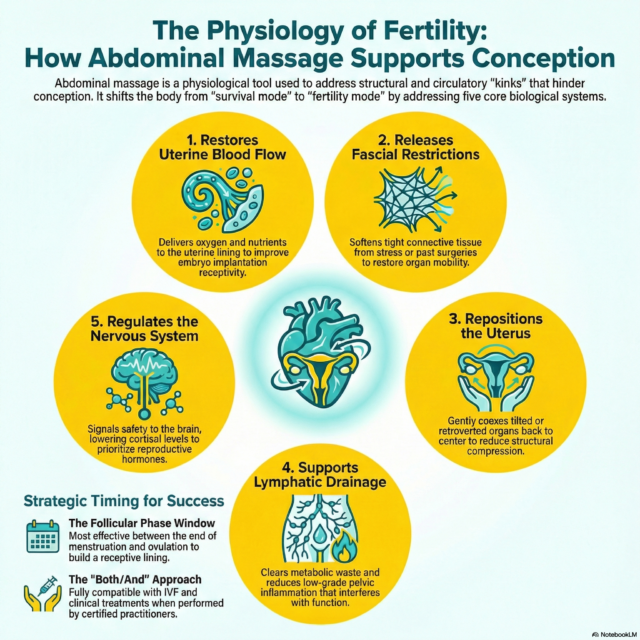
1. Restores Uterine Blood Flow
When your uterus is properly positioned and the surrounding fascia is relaxed, oxygenated blood flows freely to your uterine lining, your ovaries, and your fallopian tubes. A well-nourished uterine lining is thicker, more receptive, and better prepared to support implantation. When blood flow is compromised, conditions are compromised. Gentle abdominal massage physically opens those pathways by reducing tension in the surrounding soft tissue and encouraging fresh circulation into an area that may have been partially starved of it.
Professor’s Note: In my physiology courses, I teach students that endometrial receptivity, meaning how well the uterine lining accepts a fertilized egg, depends directly on the density and quality of spiral arteries within that lining. Those arteries only develop well when blood supply to the uterus is consistent and adequate. This is not a theory. It is observable histology.
2. Releases Fascial Restrictions
Fascia is the connective tissue that surrounds and supports every organ in your body, holding each one in its proper place while allowing the gentle movement your organs need to function. It is also the tissue that tightens in response to stress, surgery, infection, and old injury. Women who have had a C-section, an endometriosis diagnosis, or even significant emotional stress often carry fascial tension in their pelvic bowl that quietly limits organ mobility without causing obvious pain.
Skilled abdominal massage works directly with this tissue, softening restrictions and restoring the natural movement your reproductive organs need to function at their best. You can read more about how structural care supports women’s health on our Natural Fertility Enhancement Services page.
Professor’s Note: Fascia is not passive packaging. It is a living tissue densely populated with fibroblasts, the cells responsible for producing and remodeling connective tissue throughout your life. Research on fascial biology shows that mechanical stimulation, meaning skilled hands-on pressure, directly activates fibroblast remodeling. That is the cellular reason why massage produces lasting structural change rather than temporary relief.
3. Repositions the Uterus
A retroverted or tilted uterus is not a diagnosis that most conventional providers spend much time discussing, but it affects a meaningful number of women and has real implications for fertility. When the uterus is not in its naturally forward-tilting position, it can compress surrounding structures, restrict blood flow, and create an environment that makes implantation more difficult.
Certified abdominal massage uses specific, gentle techniques to encourage the uterus back toward center, reducing that compression and improving function. If you have been told you have a retroverted uterus and felt like no one offered a real next step, this is one.
4. Supports Lymphatic Drainage
The lymphatic system is your body’s primary waste-clearing network. In the pelvic region, sluggish lymphatic flow can contribute to chronic inflammation, hormonal imbalance, and a general environment that is less hospitable to conception.
Abdominal massage stimulates lymphatic movement in the abdomen and pelvis, helping clear metabolic waste and reduce the low-grade inflammation that can quietly interfere with reproductive function.
5. Regulates the Nervous System
This is the mechanism that most people don’t expect, and it may be the most important one of all. Research consistently links elevated cortisol to disrupted ovulation and reduced fertility. When your nervous system is chronically in survival mode, which is where many of us live without fully realizing it, your body deprioritizes reproduction.
This is not a moral failing. It is biology. Your body is making a rational, if deeply frustrating, choice: safety before fertility.
Abdominal massage works directly with the vagus nerve and the parasympathetic nervous system to signal safety. It helps your body remember that it is okay to let go. And when your body lets go, the conditions for conception improve. For a deeper look at how the nervous system affects women’s health in ways most people never consider, this post on stress management techniques explains the physiology in plain language.
Does Abdominal Massage Help with Implantation?
Yes, and timing matters.
The most beneficial window for abdominal massage is the follicular phase of your cycle, the days between the end of your period and ovulation. This is when your body is actively building the uterine lining that will need to be receptive for implantation. Massage during this phase supports blood flow to that developing lining at exactly the right time.
After ovulation has occurred, the approach shifts. If you are in the two-week wait, lighter and more supportive techniques are appropriate. The goal then is nervous system regulation and maintaining circulation, not the deeper structural work done earlier in the cycle.
Women from across the greater Lansing area, including Charlotte, Potterville, Dimondale, Eagle, and Portland, often ask me whether abdominal massage is compatible with IVF or other clinical options. The answer is yes, with appropriate modifications and in communication with your reproductive specialist. Abdominal massage is not an either or. It is a both and. It prepares the environment regardless of how conception happens.
A Closer Look: What a Common Clinical Pattern Reveals
The following is a composite example drawn from patterns I see regularly in my practice. No identifying information is included. This is shared for educational purposes only.
A woman in her mid-thirties came to see me after about 18 months of trying to conceive without success. She had no formal infertility diagnosis. Her cycles were regular, if slightly painful. She had a previous abdominal surgery several years prior. She described herself as someone who pushes through and noted that she rarely slows down.
During her initial assessment, I found significant fascial restriction in her lower pelvis and evidence of a moderately retroverted uterus. Her lower back carried chronic tension, and her period pain had been gradually increasing over the previous two years.
We began a series of abdominal massage sessions combined with chiropractic care focused on sacral and pelvic alignment. I also taught her a gentle self-care routine to practice at home between sessions, which is a standard part of certified abdominal massage practice because the work is cumulative, and what happens between sessions matters as much as what happens in the office.
Within two cycles, her period pain had decreased noticeably. Within four months, she was pregnant.
I share this not as a promise, because no practitioner can or should promise a specific outcome, but as an illustration of what becomes possible when structural conditions are addressed alongside functional ones. Every woman’s body is different. What stays the same is the underlying physiology, and the physiology tells a clear story about what your body needs to do its best work.
Why Who Performs This Matters as Much as the Technique
Not all abdominal massage is the same. Certified training in fertility-focused abdominal therapy requires deep knowledge of reproductive anatomy, fascial mechanics, and cycle-aware technique modification. The difference between a spa belly massage and certified therapeutic abdominal massage is significant, and it matters for your results.
I trained at University of Western States, a chiropractic college known for its emphasis on evidence-based, functionally neurological care. Most chiropractors in the greater Lansing area trained at Life or Palmer. The Western States curriculum gave me a different foundation, one that prioritizes understanding why the nervous system and structural system interact the way they do rather than simply treating the symptom in front of me.
I have been a practicing chiropractor since 2009. I teach human physiology at the college level. When I work with a woman on her fertility goals, I am reading her body the same way I read a patient case with my students: systemically, carefully, and with an eye toward root cause rather than surface symptom.
Women from Ashford Manor, Belaire Hills, Brittany Meadows, and Brookwood in Grand Ledge, as well as those who make the drive from Eagle, Dimondale, and Charlotte, are not choosing this approach because they’ve run out of options. They’re choosing it because they found a practitioner who explains the why behind the work. That explanation, that transparency, is something I take seriously. You deserve to understand what is happening in your own body.
You can learn more about my training and approach on the About page.
What to Expect at Your First Visit
Your first visit begins with a conversation. Not a questionnaire you fill out in a waiting room, but an actual conversation, because the details of your health history matter and so does the context behind them. After that, I will conduct a structural assessment of your abdomen, pelvis, and lower back.
Most women notice some immediate release during their first session. The tissues are often more responsive than expected. It is also common to feel emotional afterward. That is not unusual. Your pelvic region carries a lot, and when something that has been held tight finally lets go, the body responds in its own way.
Sessions include home instruction. I will teach you a self-care routine you can practice between appointments, in your own home, in your own time. This is what makes the in-office work last. Women who commit to a series of sessions, typically four to six over two to three months, see the most consistent results. This is not a quick fix. It is also not a mystery. It is systematic, evidence-informed care for a body that is doing its best and deserves better support.
If you are currently pregnant or think you may be pregnant, please let me know before booking. Pregnancy chiropractic care is something I offer as well, including the Webster Technique for optimal fetal positioning, and the approach changes meaningfully depending on where you are in your journey.
A Simple Practice You Can Start Today
One of the things I love about certified abdominal massage is that it is not only something I do for you. It is something I teach you to do for yourself.
The self-care component is gentle, takes five to ten minutes, and is appropriate to practice daily during your follicular phase, after your period ends and before ovulation. The basic technique involves warming your hands, applying a small amount of castor oil or a neutral carrier oil to your lower abdomen, and using slow, intentional circular strokes. Moving upward on the left side of your abdomen and downward on the right follows the natural flow of the large intestine and gently encourages circulation to the uterus below.
This is not a substitute for a professional assessment. But it is a way for you to stay connected to your body, to learn its rhythms, and to participate actively in your own care. That participation matters. Not just physically, but in the way it helps you feel less like something is being done to you and more like you are an active part of your own healing. This connects naturally to the 5 holistic approaches to improving fertility naturally shared in a related post on this site.
Is Abdominal Massage Right for You?
Consider these questions honestly:
Question
Have you been trying to conceive for six months or more without success?
Do you experience painful or irregular periods?
Have you had a C-section, abdominal surgery, or a known diagnosis of endometriosis or fibroids?
Does lower back or pelvic discomfort accompany your cycle?
Have you been told you have a retroverted or tilted uterus?
Are you looking for natural approaches to support fertility, alongside or before clinical options?
If you answered yes to three or more of these, a conversation is worth having. These are not alarm bells. They are simply signals that your body may be carrying structural or circulatory patterns that abdominal massage can specifically address.
This self-assessment is for educational purposes only and does not constitute medical advice. Please consult with a qualified healthcare provider for personalized guidance.
Scoring:
0 to 2 Yes answers: General wellness-focused care may be most appropriate as a starting point.
3 to 4 Yes answers: There is likely a structural component worth evaluating with a certified practitioner.
5 to 6 Yes answers: An in-depth assessment is strongly worth prioritizing. Your body is giving you clear signals.
Frequently Asked Questions
What is abdominal massage for fertility?
Abdominal massage for fertility is a certified therapeutic technique that uses gentle, intentional pressure on the abdomen and pelvis to improve blood flow to the reproductive organs, release fascial restrictions, reposition the uterus when needed, and support the nervous system conditions that allow conception to occur. It is distinct from general massage in that it is cycle-aware, anatomically specific, and includes a self-care teaching component for home practice.
How does fertility massage work?
Fertility massage works through five primary mechanisms: restoring uterine blood flow, releasing fascial restrictions around the reproductive organs, repositioning the uterus toward its optimal position, stimulating lymphatic drainage to reduce pelvic inflammation, and calming the nervous system to reduce cortisol’s disruptive effect on ovulation. Each mechanism supports the others, creating a more receptive and better-nourished environment for conception.
When should you do a fertility massage?
The most effective timing for abdominal massage is during the follicular phase of your cycle, after your period ends and before ovulation occurs. This is when the uterine lining is actively developing and blood flow has its greatest impact on lining quality and receptivity. After ovulation, lighter and more supportive techniques are appropriate. Abdominal massage is not recommended during active menstruation.
Does massaging the uterus help implantation?
It can, primarily through its effect on uterine lining development before implantation occurs. A uterine lining with consistent blood flow is thicker, better oxygenated, and more receptive to a fertilized egg. The key is timing: the structural work done in the follicular phase directly affects the quality of the environment available at implantation.
Why does massaging the belly help in fertility?
The belly houses the uterus, ovaries, fallopian tubes, and the connective tissue that holds them all in place. When this tissue is tight or restricted, or when the organs themselves are not in optimal position, blood flow is limited, nerve communication is compromised, and the environment for conception is less hospitable. Abdominal massage addresses these physical factors simultaneously, creating conditions the body needs to do what it is designed to do.
What kind of massage is best for fertility?
Certified therapeutic abdominal massage, performed by a practitioner with specific training in reproductive anatomy and cycle-aware technique, is the most targeted approach for fertility support. It is distinct from general relaxation massage in its anatomical specificity, its understanding of cycle timing, and its inclusion of home self-care instruction between sessions.
Is massage safe when trying to conceive?
Yes, with appropriate timing and technique. During the follicular phase, structural work supports blood flow and uterine positioning. During the luteal phase, gentle nervous system focused approaches support relaxation and reduce cortisol. Always communicate openly with your practitioner about where you are in your cycle and whether you may have conceived.
Can I get a massage during the two-week wait?
Light, gentle massage focused on nervous system relaxation can be appropriate during the two-week wait. Deeper structural or abdominal work is not recommended. The priority during the two-week wait is warmth, rest, and nervous system support. When in doubt, check with your healthcare provider.
Ready to Have a Real Conversation?
You have done the research. You are asking the right questions. That already tells me something about who you are.
Dr. Herrst offers a free consultation where we talk through your health history, your cycle patterns, your structural picture, and your goals. Together, we build a plan that makes sense for your body and your life. Not a protocol pulled from a textbook. A plan built from what you actually need.
Women from Potterville, Dimondale, Eagle, Charlotte, Portland, and across the greater Lansing area come to this office because they found a chiropractor who explains the why, who teaches as well as treats, and who takes your fertility goals as seriously as you do.
Schedule Your Free Consultation
Or call us directly at 517-980-0366. We are located at 221 S Bridge St, Room 3, Grand Ledge, MI 48837.