
abdominal

Chiropractic

Craniosacral Therapy: What a Chiropractic Physician Uses When Your Nervous System Needs More Than an Adjustment

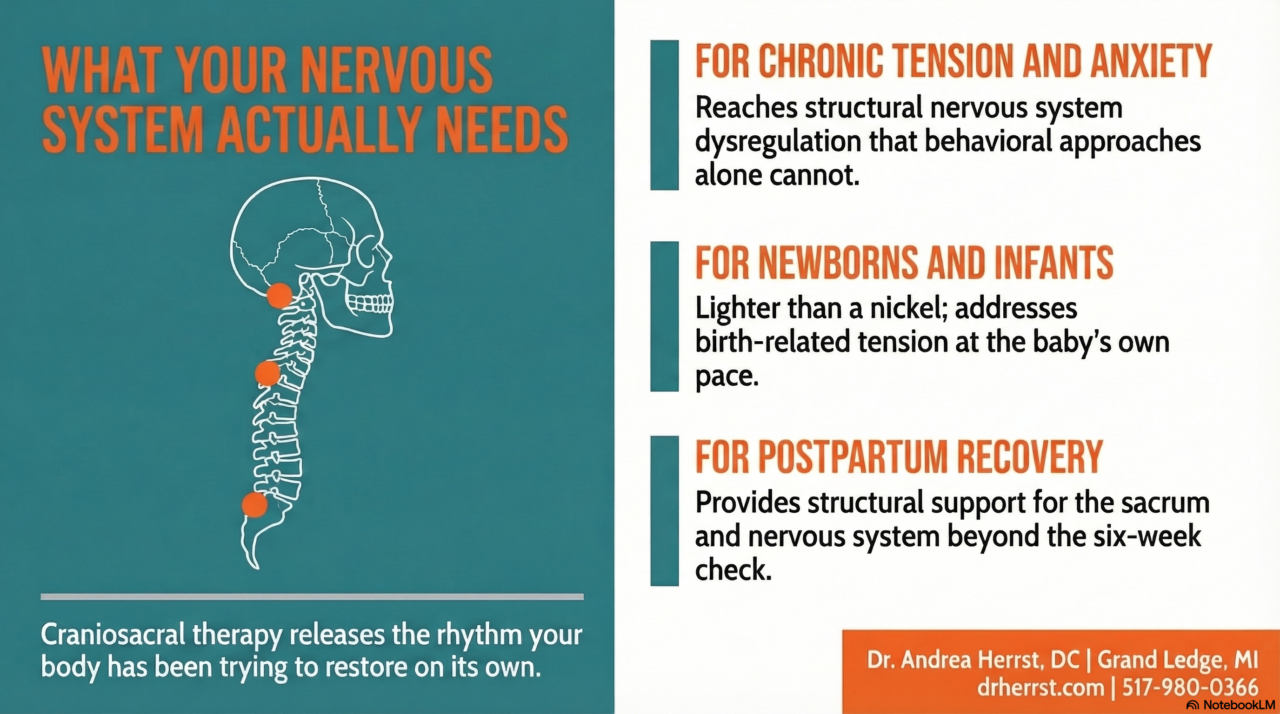
Craniosacral therapy is a gentle, hands-on technique used by chiropractic physicians to release tension held deep in the nervous system. It can help with headaches, anxiety, sleep, postpartum recovery, and even feeding and settling difficulties in newborns. There is no force involved. Most people describe it as one of the most deeply calming things their body has ever experienced. If you have wondered whether there is something more than what you have already tried, this is worth understanding. Prefer to listen instead? Something Hasn’t Felt Right for a While You know the feeling. Not dramatic. Not emergency-room urgent. Just a low-grade hum of something off that you have gotten very good at pushing through. Maybe it is the headache that shows up every afternoon like it has somewhere to be. Or the tension that lives between your shoulder blades and the base of your skull, the kind that a hot shower helps for twenty minutes before it comes right back. Maybe your child has been harder to settle than you expected, and every explanation you have been given starts with “some babies are just like that.” Maybe you have not slept deeply in so long that you genuinely cannot remember what rested feels like. You have probably been told your labs look normal. That everything checks out. That stress is likely the cause. You have stretched. You have tried the supplements. You have done the things you were supposed to do. And the hum is still there. Here is something worth considering. The nervous system is patient. It will keep adapting to whatever load you place on it. Over time, that adaptation becomes the new normal. Tired becomes “just how I am.” Tense becomes “just how I carry stress.” The afternoon headache becomes “just part of my week.” The body does not announce that it is struggling. It just quietly reorganizes itself around the problem. If you recognize this pattern, these stress management strategies are worth reading alongside this post. Every month that pattern runs unaddressed, it becomes more familiar to your body than the alternative. The body does not forget. It learns. That is not a character flaw. It is not a failure of willpower. It is physiology. And physiology can change when you address the right thing. What If Your Nervous System Is the Root, Not the Symptom? Craniosacral therapy is a gentle, hands-on technique that works with the deepest structures of your nervous system. Not the muscles on the surface. Not the joints in isolation. The bones of your skull, your spine, and your sacrum, and the fluid that moves through all of them. Here is the physiology in plain terms. Your body produces a fluid called cerebrospinal fluid. It bathes your brain and spinal cord and moves in a slow, rhythmic pulse that has nothing to do with your heartbeat and nothing to do with your breathing. It is its own system, running quietly underneath everything else. A trained practitioner can feel that rhythm with her hands. When something disrupts that rhythm, the nervous system notices. It compensates. It adapts. And the adaptation shows up as the thing you came in for, whether that is the headache, the tension that will not release, the child who will not settle, or the anxiety that does not have a clean explanation. Craniosacral therapy finds where the rhythm is restricted and releases it. Gently. With no force. The work is so light that most people are surprised by how much they feel. This is not a wellness trend. It is a clinical tool used inside a chiropractic physician’s practice by a physician trained to understand the nervous system at depth. If you have wondered whether your current care is getting all the way to the root, this is the question worth asking. If your first instinct is to wonder whether this is real, that is a good instinct. Bring it. The evidence is worth knowing, and it will be addressed in the FAQ below. Dr. Herrst’s Note — Physiology Corner Craniosacral therapy works with a rhythm your body already produces on its own. I can feel it with my hands. When it is restricted, I find where and release it. Gently. With no force at all. The response often surprises people who expected something more dramatic. The body does not need drama. It needs precision. That is what this work is.   What Craniosacral Therapy Actually Addresses, and Who It Is For Some of the patterns that bring people to this kind of care most often: headaches that arrive without a clear cause, tension that lives in the upper neck and base of the skull, a newborn who seems uncomfortable in ways no one can quite name, postpartum recovery that still does not feel complete months after delivery, and anxiety that does not have a clean explanation. None of these have to be permanent. They are patterns. And patterns can change. To learn more about Dr. Herrst’s approach and background, her About page gives the full picture. For the Tension You Have Learned to Live With The nervous system can get stuck in a state of low-grade alert. Not panic. Not crisis. Just a persistent background hum of not-quite-right that has become the new baseline. Most approaches to chronic tension and anxiety focus on behavior. Breathe differently. Think differently. Move more. Those things matter. But when the nervous system has a structural component to its dysregulation, behavioral approaches alone hit a ceiling. Craniosacral therapy works with the structural side of that equation. The bones of the skull and the upper cervical spine have a direct relationship with the nervous system’s ability to shift out of a stress response. When those structures are restricted, the system stays elevated. When the restriction is released, the body finally gets the signal that it is allowed to come down. This is the piece that grounding techniques and breathing exercises cannot always reach on their own. If you have worked hard on the
Chiropractic

What Abdominal Massage Actually Does Inside Your Body (And Why It Matters for Fertility)

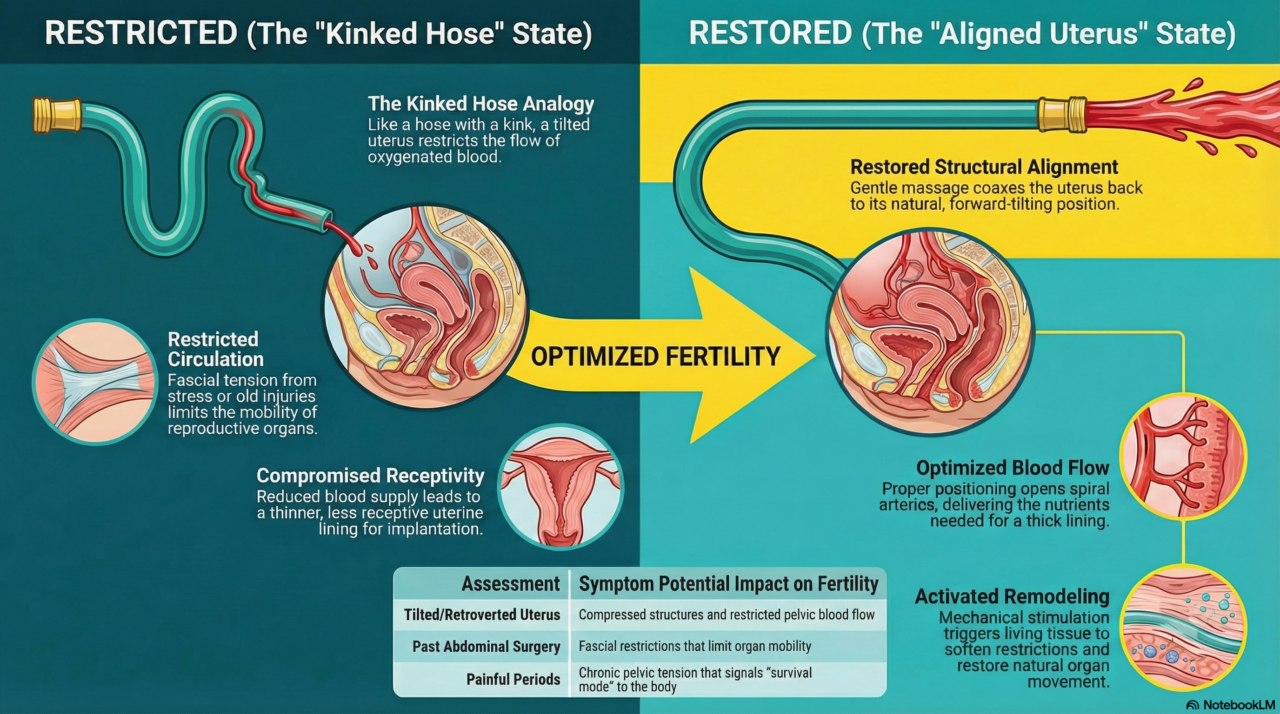
Abdominal massage for fertility works by improving blood flow to the uterus and ovaries, releasing fascial restrictions that limit organ mobility, gently repositioning the uterus when structural alignment is needed, supporting lymphatic drainage, and calming the nervous system so your body can shift out of survival mode and into the conditions where conception becomes possible. It is both mechanical and physiological, grounded in anatomy, and it works best when performed by a certified practitioner who understands the full picture of your reproductive health. Prefer to listen instead? You already know what you’re hoping for. You don’t need anyone to describe it. The positive test. The way you’d tell your husband. The way your older kids would react. You carry that picture with you, and it is the reason you keep asking questions, keep researching, keep trying. So let’s start there. With where you’re going, not where you’ve been. Most women who come to see me have spent months, sometimes longer, asking some version of the same question: “What is wrong with me?” They’ve tracked their cycles. They’ve taken the supplements. They’ve read the books and followed the advice and done everything the right way. And they are exhausted from trying so hard and still not having answers that feel real. Here is what I want you to consider. What if the better question isn’t “what’s wrong with me?” but “what does my body need that it isn’t getting right now?” That one shift changes everything. For many women, the answer turns out to be surprisingly physical. Not emotional. Not mysterious. Structural. Circulatory. Mechanical. And that is where abdominal massage enters the conversation, not as a last resort or a long shot, but as a legitimate physiological tool with deep roots in traditional medicine and a clear anatomical explanation for why it works. Why Your Uterus Position Matters More Than Anyone Told You Most women have never been told that their uterus has a position, that it can shift from that position, and that when it does, the entire environment for conception changes with it. Think about a garden hose lying in your backyard on a summer afternoon. The water is there. The pressure is there. But if someone steps on that hose, or it bends around a corner too sharply, the water slows to a trickle. It can’t reach the garden no matter how much pressure is behind it. Your uterus, ovaries, and fallopian tubes need a steady, rich flow of oxygenated blood to do their jobs. When your uterus is tilted forward, backward, or to one side, which is far more common than most women know, or when the connective tissue surrounding it has tightened from past surgeries, old injuries, previous pregnancies, or even years of sitting in the same position, that flow gets restricted. Not cut off completely. Just kinked. And a kinked hose doesn’t grow much of anything. Research published through the National Institutes of Health has consistently shown that adequate uterine blood flow is one of the foundational requirements for successful implantation and early pregnancy. This isn’t alternative medicine. This is anatomy. Abdominal massage, performed by someone with real training in soft tissue work and reproductive anatomy, gently coaxes those structures back toward optimal position. It releases the restrictions. It restores circulation. It helps your body do what it already knows how to do. Your body was designed for this. Sometimes it just needs someone who understands the design. What Abdominal Massage for Fertility Actually Does Inside Your Body Here is the physiology, explained the way I explain it to my students at Lansing Community College and to the women who sit across from me in my Grand Ledge office. No jargon. Just the real mechanics. 1. Restores Uterine Blood Flow When your uterus is properly positioned and the surrounding fascia is relaxed, oxygenated blood flows freely to your uterine lining, your ovaries, and your fallopian tubes. A well-nourished uterine lining is thicker, more receptive, and better prepared to support implantation. When blood flow is compromised, conditions are compromised. Gentle abdominal massage physically opens those pathways by reducing tension in the surrounding soft tissue and encouraging fresh circulation into an area that may have been partially starved of it. Professor’s Note: In my physiology courses, I teach students that endometrial receptivity, meaning how well the uterine lining accepts a fertilized egg, depends directly on the density and quality of spiral arteries within that lining. Those arteries only develop well when blood supply to the uterus is consistent and adequate. This is not a theory. It is observable histology. 2. Releases Fascial Restrictions Fascia is the connective tissue that surrounds and supports every organ in your body, holding each one in its proper place while allowing the gentle movement your organs need to function. It is also the tissue that tightens in response to stress, surgery, infection, and old injury. Women who have had a C-section, an endometriosis diagnosis, or even significant emotional stress often carry fascial tension in their pelvic bowl that quietly limits organ mobility without causing obvious pain. Skilled abdominal massage works directly with this tissue, softening restrictions and restoring the natural movement your reproductive organs need to function at their best. You can read more about how structural care supports women’s health on our Natural Fertility Enhancement Services page. Professor’s Note: Fascia is not passive packaging. It is a living tissue densely populated with fibroblasts, the cells responsible for producing and remodeling connective tissue throughout your life. Research on fascial biology shows that mechanical stimulation, meaning skilled hands-on pressure, directly activates fibroblast remodeling. That is the cellular reason why massage produces lasting structural change rather than temporary relief. 3. Repositions the Uterus A retroverted or tilted uterus is not a diagnosis that most conventional providers spend much time discussing, but it affects a meaningful number of women and has real implications for fertility. When the uterus is not in its naturally forward-tilting position, it can compress surrounding structures, restrict blood flow, and

Scroll to Top