


It’s 10:47 PM on a Tuesday in January. You finally sit down after getting the kids to bed, finishing the laundry, and responding to those work emails that couldn’t wait until morning. Your shoulders are somewhere up by your ears. There’s a dull, grinding ache between your shoulder blades that’s been there since… Thursday? Last month? You honestly can’t remember when it started. You just know it’s always there now.
You roll your neck and hear that crunchy sound, the one that makes you wince every time you check your blind spot while driving. Your jaw aches from clenching during that conference call this afternoon. When you finally exhale, you realize you’ve been holding your breath for who knows how long. Even your steering wheel probably has your fingerprints permanently embedded in it from the death-grip you maintain during your commute on 496.
You’ve tried the deep breathing apps. You’ve watched the YouTube videos about five-minute stress relief. You even bought that fancy ergonomic chair that promised to fix everything. But every morning, you wake up with that same tension. By Wednesday, your upper back feels like someone poured concrete between your shoulder blades. By Friday, you’re taking ibuprofen just to get through the afternoon without wanting to crawl under your desk.
This isn’t just about feeling tired anymore. You’re snapping at your kids over nothing. Your spouse asked if you’re okay last week, and you said “I’m fine” even though you’re clearly not. You’re 38 years old, and you feel like you’re 58. The headaches are getting worse. Your doctor mentioned your blood pressure is creeping up. And if we’re being completely honest here, somewhere in the back of your mind you’re wondering: is this just what life feels like now? Is this just part of being an adult with responsibilities in Michigan, where gray skies seem to last from November through April and “self-care” feels like one more thing you don’t have time for?
Here’s what nobody’s telling you about stress management techniques. Most of them treat stress like it’s all in your head. Deep breathing. Meditation. Mindfulness. Positive thinking. Those things can help, sure. But when stress has been living in your body for months or years, showing up as physical tension, pain, and nervous system dysfunction, you can’t just breathe it away. Your body isn’t following your mind’s instructions anymore. It’s stuck in a pattern, and that pattern is structural.
What Your Body Is Actually Doing Under Chronic Stress
I’m Dr. Andrea Herrst, and I’ve been a chiropractor here in the Lansing area for over a decade. I also teach Physiology as an adjunct professor at Lansing Community College, which means I spend a lot of time explaining to students how the human body is designed to function versus how it actually functions when we’re under constant stress. There’s often a big gap between the two.
I’ve spent thousands of hours with patients who walked into my office saying some version of what you’re probably thinking right now: “I’m just stressed. I thought it would get better on its own. I didn’t think I needed to see someone about this.”
Here’s the pattern I see almost every single day. Someone comes in because their upper back hurts, or they’re getting tension headaches three times a week, or they can’t turn their neck to check their blind spot without sharp pain shooting down their shoulder. When I ask about their stress level, they kind of laugh and say, “Oh, it’s always high. That’s just my life. That’s just what happens when you’re trying to balance work and family and everything else.” Like stress is this separate thing floating around them that has nothing to do with why they’re sitting in my office unable to lift their arm above shoulder height.
But here’s what’s actually happening in your body when you’re under chronic stress, and this is where most stress management advice completely misses the mark.
Your Body’s Gas Pedal Gets Stuck
Your nervous system doesn’t know the difference between running from actual danger and running late to a meeting. When you’re stressed, your body hits the gas pedal, what scientists call your fight-or-flight response. Your muscles tense up to prepare for physical threat. Your shoulders rise toward your ears. Your jaw clenches. Your breathing gets shallow and moves up into your chest instead of deep into your belly.
This response is supposed to be temporary. Encounter threat, hit the gas, respond, then hit the brakes and return to normal. That’s how human bodies are designed to handle stress according to basic physiology.
But when you’re stressed every single day? When you wake up already thinking about everything on your to-do list, spend eight hours hunched over a computer with your shoulders rolled forward, skip lunch because there’s too much to do, deal with traffic on the way home, then come home to more responsibilities? Your body never gets the signal to hit the brakes. The gas pedal stays pressed down. Those muscles stay tense. Day after day. Week after week. Month after month.
Here’s the part most people don’t understand. That tension isn’t “all in your head.” It’s not something you can just decide to release. It’s real, physical, structural tension that’s pulling on your spine, compressing nerves, restricting blood flow, creating inflammation, and signaling your brain that your body is still under threat. Which keeps the gas pedal pressed. Which creates more tension. And the cycle continues.
According to research from the American Chiropractic Association, chronic stress creates measurable changes in spinal alignment and muscle tension patterns that can persist even after the mental stress has passed.
The Mental-Only Approach Is Using a Bucket to Drain a Flooded Basement While the Pipes Are Still Bursting
The mainstream stress management advice treats your body like it’s just following orders from your brain. They tell you to think positive thoughts, practice gratitude, do some deep breathing, maybe try a meditation app. And yes, those things help your mental state. They absolutely have value.
But when you have structural tension in your spine, nerve interference affecting how signals travel between your brain and body, and a nervous system that’s been stuck with the gas pedal pressed for so long it doesn’t remember what normal feels like? You’re trying to drain a flooded basement with a bucket while the pipes are still bursting. You might get some temporary relief, but the underlying problem is still there, still getting worse.
I’ve worked with parents who thought their upper back pain was just from “getting old” or “sleeping wrong.” Then we addressed the physical stress pattern in their spine and nervous system, and suddenly they could play with their kids after work without collapsing on the couch in pain. I’ve seen desk workers who assumed constant neck tension was just part of having an office job, until we reset their nervous system function and taught them how to interrupt the stress-tension cycle before it becomes pain.
You’re not broken. Your body is responding exactly the way it’s designed to. The problem isn’t that you’re weak or that you can’t handle stress. The problem is that nobody taught you that stress becomes a physical, structural pattern that needs to be addressed physically and structurally.
When we address the physical component of stress, patients consistently report they sleep better, have more energy, don’t wake up already exhausted, can actually relax when they try to relax, and feel like themselves again instead of feeling like they’re just surviving.
The Body-Based Approach to Stress Management: The 4 Pillars of Physical Stress Release
Most stress management techniques focus exclusively on calming your mind. And that matters, truly it does. But if you’ve tried meditation and breathing exercises and positive thinking and you still wake up with tension, still feel like you’re carrying the weight of the world on your shoulders, still can’t get your body to relax even when you’re trying to rest, it’s because you’re missing the physical component.
Your body is holding stress in your muscles, your spine, and your nervous system. You need techniques that address stress where it actually lives.
Here are the four pillars that actually work when stress has become a physical pattern.
Pillar 1: Recognize Your Body’s Warning Signs
What This Means
Your body is constantly sending you signals about stress overload. Most people ignore these signals until they become unbearable. The key is learning to read your internal dashboard before you hit empty.
Why It Matters
Remember those questions people search for about “warning signs of stress“? Your body shows you that stress is building long before it becomes a crisis. Tight shoulders. Jaw clenching. Shallow breathing. Tension headaches. Digestive problems. Trouble falling asleep or staying asleep. These aren’t separate problems. They’re all connected to your nervous system being stuck with the gas pedal pressed.
Research from the Mayo Clinic shows that chronic stress creates measurable changes in muscle tension patterns, spinal alignment, and nervous system function. These changes show up physically before they show up as diagnosed conditions. Your body is trying to warn you.
What to Watch For
Persistent muscle tension that doesn’t release with rest. Changes in your posture (shoulders rolling forward, head jutting forward). Pain that moves around (upper back one day, neck the next, then a headache). Difficulty taking a full deep breath. Feeling wired and tired at the same time. Waking up feeling like you didn’t actually rest even though you slept seven hours.
What It Looks Like in Practice
When you start noticing tension building on Tuesday instead of waiting until Friday when your neck is completely locked up, you can interrupt the pattern before it becomes pain. This is the difference between managing stress and being managed by it.
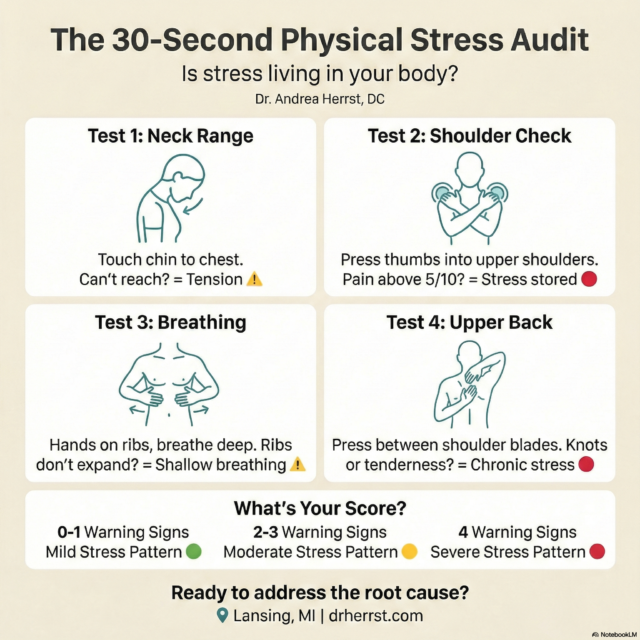
The 30-Second Physical Stress Audit
Before we go further, let’s do something different than just reading about stress. Let’s actually check what’s happening in your body right now.
I want you to pause and actually do this. Not just think about doing it. Actually stop and check.
Test 1: Neck Range of Motion
Try to touch your chin to your chest without forcing it. Can you do it without pain? If you feel pulling, tightness, or you can’t get your chin within two inches of your chest, that’s a sign of chronic tension in your neck and upper back muscles.
Test 2: Shoulder Tension Check
Press your thumbs firmly into the muscles at the top of your shoulders (your upper traps, the muscles that run from your neck out toward your shoulder). Press and hold for three seconds. On a scale of 1 to 10, how tender is that? If it’s above a 5, you’re carrying significant physical stress in those muscles.
Test 3: Breathing Capacity
Place your hands on the sides of your ribcage. Take a deep breath in through your nose. Can you feel your ribs expand outward to the sides? Or does your breath stay shallow and move mostly up into your chest and shoulders? If you can’t expand your ribcage, your breathing pattern has adapted to chronic stress.
Test 4: Upper Back Tension
Have someone press their thumbs between your shoulder blades along your spine. Or if you’re alone, try to reach back and press on those muscles yourself. How much tenderness do you feel? Does it feel like there are knots or hard spots?
Your Score
- 0-1 tender areas: Mild physical stress pattern
- 2-3 tender areas: Moderate physical stress pattern (your body is starting to get stuck)
- All 4 areas tender or limited: Severe physical stress pattern (your nervous system needs help resetting)
This isn’t a diagnosis. It’s a snapshot of how much physical tension you’re carrying right now. And here’s the important part: this tension didn’t happen overnight. It built up gradually as your body adapted to chronic stress. Which means it needs a systematic approach to release it, not just a quick fix.
Pillar 2: Release the Physical Tension (The “Flush” vs. “Filter” Approach)
If you clicked on this article hoping for a five-minute stress relief hack, I get it. When your neck is screaming and you have three more hours of work ahead of you, you need something that helps NOW. That’s why this pillar starts with immediate-relief techniques you can use today. But if we stop there, you’ll be back in the same pain tomorrow. So we’re also giving you the sustainable system that prevents the tension from building back up.
What This Means
There are two types of stress relief. Quick releases that help in the moment (the “flush”), and long-term regulation that prevents buildup (the “filter”). You need both.
Why It Matters
Remember those searches for “how to flush stress out of your body” and “how to reduce stress in 5 minutes”? People aren’t wrong to want quick relief. But if temporary relief is all you’re getting, you’re stuck in a cycle of constant management instead of actually solving the problem.
The “Flush” – Immediate Relief Techniques
Targeted Stretching: Focus on the specific muscles that hold stress. The upper trapezius muscles at the top of your shoulders, the levator scapulae muscles that run from your neck to your shoulder blade, and the muscles at the base of your skull are where most people store tension. Gentle, sustained stretches for these areas can provide relief within minutes.
Self-Massage Techniques: Using a tennis ball or foam roller against a wall, you can apply pressure to trigger points and knots that have formed in chronically tight muscles.
Strategic Breathing: This isn’t just “take a deep breath.” Use breathing with a longer exhale than inhale to activate your body’s brakes (the rest-and-digest response) that counteracts the gas pedal state.
Heat or Cold Application: Heat can relax chronically tight muscles. Cold can reduce inflammation and reset pain signaling. Knowing when to use which one matters.
The “Filter” – Long-Term Regulation
Spinal Alignment: Remove nerve interference through proper spinal care. This is where chiropractic care combined with complementary therapies becomes essential, not optional.
Postural Corrections: Prevent tension from building in the first place. If you spend eight hours a day with your head forward and shoulders rounded, no amount of stretching at the end of the day will fix that.
Nervous System Reset: We’ll explain exactly how this works in the next section.
Movement Patterns: Short frequent movement breaks are more effective than long sessions at the end of the day. Try a quick walk along the Grand River trail during your lunch break, or do a two-minute postural reset while grabbing groceries at Horrocks. These small, local habits make a big difference.
What It Looks Like in Practice
The flush gets you through today without suffering. The filter means you don’t wake up tomorrow in the same pain. This is why people who only do yoga, or only get massages, or only try to relax often find that relief is temporary. You need structural correction, not just symptom management.
Pillar 3: Reset Your Nervous System (Not Just Your Mind)
This is where we get to the heart of why chiropractic care is uniquely positioned to address chronic stress in ways that other approaches can’t.
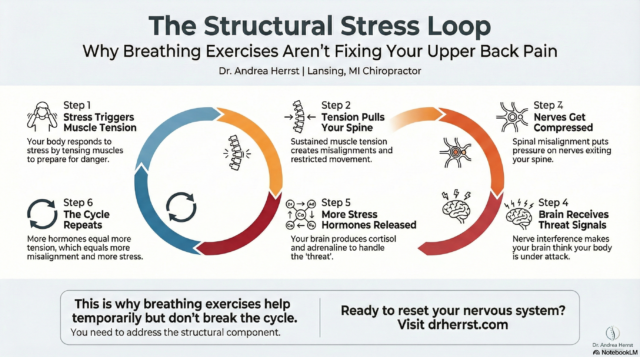
Understanding the Structural Stress Loop
Your spine and nervous system are directly connected. When your spine is misaligned from chronic tension and poor posture, it creates interference in how your nervous system functions. This keeps you stuck in gas pedal mode even when you’re trying to relax.
Here’s the mechanism most people have never heard explained. Let me walk you through the structural stress loop that keeps you trapped:
[DIAGRAM: The Structural Stress Loop – 6-Step Circular Process]
Step 1: Stress Triggers Muscle Tension
Stress causes your muscles to tense (this is normal, adaptive, protective).
Step 2: Tension Pulls on Your Spine
Sustained muscle tension pulls on your spine, creating misalignments and restricted movement in your vertebrae.
Step 3: Spinal Misalignment Creates Nerve Pressure
Spinal misalignment creates pressure on the nerves that exit your spine and travel to every part of your body.
Step 4: Nerve Interference Disrupts Signals
Nerve interference disrupts the signals traveling between your brain and your body. Your brain receives faulty information suggesting your body is under threat or not functioning properly.
Step 5: Brain Responds with More Stress Hormones
Your brain responds to this threat signal by producing more stress hormones (cortisol, adrenaline) and keeping your body’s gas pedal activated.
Step 6: The Loop Continues
More stress hormones create more muscle tension, which pulls on your spine even more, which creates more nerve interference, which signals more threat to your brain. And the loop continues.
This is why your current stress management methods aren’t working. They’re trying to interrupt the loop at Step 1 (reduce the mental stress) while Steps 2 through 6 are still running on autopilot.
The Science Behind the Solution
Research published in the Journal of Manipulative and Physiological Therapeutics shows that chiropractic adjustments can improve nervous system regulation. Studies from the National Institutes of Health demonstrate that spinal manipulation can reduce cortisol levels and improve heart rate variability, both markers of improved nervous system function. This isn’t just about feeling better. It’s measurable physiological change.
According to Wikipedia’s overview of the autonomic nervous system, the balance between your gas pedal (sympathetic) and brakes (parasympathetic) systems determines your body’s stress response. Spinal health directly influences this balance.
Why It Matters
This loop is why you can do all the meditation and breathing exercises in the world and still wake up tense. The structural interference in your spine keeps your nervous system stuck in the stress response regardless of what your mind is trying to tell it.
How to Apply It
Chiropractic Adjustments: Remove the structural interference and restore proper movement to your spine. This changes the signals your nervous system receives, allowing it to shift out of perpetual gas pedal mode.
Regular Spinal Check-Ups: Catch misalignments before they become pain. Think of this like maintaining your car. You don’t wait for the engine to explode before you change the oil.
Postural Awareness: Every hour, check: are your shoulders back? Is your head over your shoulders, not jutting forward? Are you breathing fully or shallow?
Movement Breaks: Two minutes every hour beats trying to fix eight hours of damage in one thirty-minute session.
What It Looks Like in Practice
Patients often tell me after their first few adjustments, “I didn’t realize how tense I was until I wasn’t anymore.” They sleep better without trying. They notice they’re not clenching their jaw all day. Their shoulders drop away from their ears without them having to consciously relax. This isn’t just “feeling relaxed.” This is their nervous system actually functioning the way it’s designed to.
Addressing the Common Frameworks
You’ve probably seen the “5 C’s of stress management” or the “3-3-3 rule for anxiety” if you’ve searched for stress help online. Those frameworks are fine for acute stress, for moments of overwhelm. But they weren’t designed for someone whose body has been in a stress state for months or years. They’re mental techniques for a physical, structural problem. That’s why they help temporarily but don’t solve the underlying issue.
The Vagus Nerve Connection
The vagus nerve, which is the main nerve of your body’s brakes (rest-and-digest response), travels right alongside your spine. Spinal health directly influences vagus nerve function, which directly influences your body’s ability to shift out of stress mode. This is basic anatomy and physiology that I teach at Lansing Community College, but it’s rarely explained in the context of stress management.
Pillar 4: Build Sustainable Stress Resilience
What This Means
The goal isn’t to eliminate stress from your life. That’s impossible, and honestly, not even desirable. Some stress is healthy and motivating. The goal is to build a body and nervous system that can handle stress without breaking down, that processes stress instead of storing it as tension.
Why It Matters
Resilience means stress doesn’t accumulate and compound. You have hard days, absolutely. But you recover. Your body bounces back instead of staying stuck in pain and tension. You don’t carry Tuesday’s stress into Wednesday, and you don’t carry the week into the weekend.
How to Build It
Consistent Spinal Care: Think of this like maintaining a high-performance vehicle. You don’t wait until the engine light is on and the car won’t start. You do regular tune-ups to prevent major breakdowns.
Daily Micro-Practices: Two-minute breathing resets throughout the day. Hourly posture checks. Intentional movement between tasks. These small actions prevent the big accumulation.
Proper Ergonomic Support: Your environment either fights you or helps you. If you’re sitting in a way that creates tension for eight hours, no amount of evening stretching will fix that.
Personal Awareness: What situations trigger your body to tense up? What time of day do you notice it most? Where in your body do you feel it first? The more aware you become, the earlier you can intervene.
What It Looks Like in Practice
Instead of barely surviving from weekend to weekend, feeling exhausted by Wednesday and just trying to make it to Friday, you have energy in the middle of the week. You can play with your kids after work instead of collapsing on the couch. You sleep through the night because your body actually feels safe enough to fully relax. You still have stress in your life, but it doesn’t own you anymore.
Your body isn’t designed to just survive stress. It’s designed to adapt, recover, and become stronger through challenge. But it needs the right support to do that. You handle difficult things every day. Learning to work with your nervous system instead of against it is well within your capability. These aren’t complicated techniques. They’re simple practices applied consistently.
Relief. Energy. Sleep. Presence with your family. The ability to enjoy your life instead of just getting through it. That’s what sustainable stress resilience looks like.
Your Body Deserves Better Than “Just Managing”
Here’s what we know. You’re dealing with real, physical tension that shows up as pain, stiffness, headaches, and exhaustion that no amount of sleep seems to fix. You’ve tried things that helped temporarily but didn’t last. You’re worried this is just how life feels now. Maybe you’re even wondering if you’re too young to feel this old, if this is just what happens when you’re an adult with responsibilities.
But here’s the truth your body is trying to tell you through those warning signs: this isn’t normal, and it doesn’t have to be your reality.
The difference between someone who manages their stress and someone who’s managed by it often comes down to one thing: addressing the physical component. Your nervous system. Your spine. The structural patterns that keep your body stuck in stress mode even when you’re trying to relax.
The warning signs you’re experiencing right now, that upper back tension, those headaches, the trouble sleeping, the constant fatigue, they’re not the problem. They’re your body asking for help before something bigger breaks. And here’s what matters: you’re capable of giving your body that help.
The decision in front of you isn’t really about whether to book a chiropractic appointment. It’s about whether you’re ready to stop accepting constant tension and pain as just “part of life.” It’s about whether you believe your body deserves actual support, not just coping mechanisms.
If you’re reading this and thinking, “This is exactly what I’m dealing with,” here’s what I want you to know. You don’t have to keep living with constant tension. You don’t have to accept that pain and exhaustion are just part of being a responsible adult. And you don’t have to figure this out alone.
At our practice here in Lansing, we specialize in helping people address the physical manifestations of chronic stress. Not through temporary fixes, but through understanding what’s actually happening in your body and creating a personalized plan to restore proper function to your nervous system and spine.
We offer complimentary consultations where we can assess how stress is affecting your body, identify specific areas of tension and misalignment, and create a clear plan for relief and recovery. No pressure. No long-term commitments required up front. Just an honest conversation about what’s going on and whether we can help.
Take as much time as you need to think about this. I’m not here to convince you of anything. The people who do well with this approach are the ones who can’t go another day feeling the way they feel right now. If that’s you, we’re here. If you’re not there yet, I completely understand.
Your body has been carrying this stress for long enough. It’s been sending you signals, asking for support, trying to tell you something important. Maybe it’s time to listen.
Call our office at 517-980-0366 or visit drherrst.com to schedule your complimentary consultation and have an honest conversation about what’s happening in your body and how we can help you feel like yourself again.
Relief. Recovery. The ability to sleep through the night, play with your kids without pain, show up for your life instead of just surviving it. That’s not too much to ask for. That’s what your body is designed for when it has the right support.
About Dr. Andrea Herrst
Dr. Andrea Herrst is a chiropractor serving the Grand Ledge and Greater Lansing, Michigan area, and an adjunct professor of Physiology at Lansing Community College. She specializes in helping patients address the physical manifestations of stress through nervous system care and spinal health.